
How to Check Criminal History in Clarence
Begin a Clarence criminal-record search by naming the document needed. Clarence holds reports created by its police function. The county sheriff is the first official call for Clarence custody and booking details. The circuit clerk maintains the Clarence court file for ordinance and state cases handled at Shelbyville, and the Missouri Central Repository supplies statewide criminal-history products. There is no official Clarence police request form, court-search form, city booking roster, or police app to bridge those offices.
- Ask the City of Clarence for its police records custodian and the accepted request method.
- Request the incident or arrest narrative with date, place, report number, and desired format.
- Call the Shelby County sheriff at 573-633-2161 for the holding facility, booking, bond, or release facts.
- Search Case.net, then contact the circuit clerk for the ordinance or state court file.
- Use MACHS only when an official statewide open-record check or fingerprint self-review fits the question.
Each result has a boundary. Police reports describe the city response. Booking records show custody at intake. Court dockets show filed counts and their outcomes. A statewide name check returns possible matches from Missouri’s open repository data.
Clarence Ordinance Record Route
Clarence made a distinctive court choice under Missouri law. Its code assigns ordinance violations to a Shelby County associate circuit judge at the courthouse in Shelbyville. The arrangement means “municipal” describes the source of the ordinance, not a separate Clarence courtroom or online docket. A report remains with Clarence police, while the related judicial record moves to the county-seat court.
The official Clarence court code provision documents that assignment.
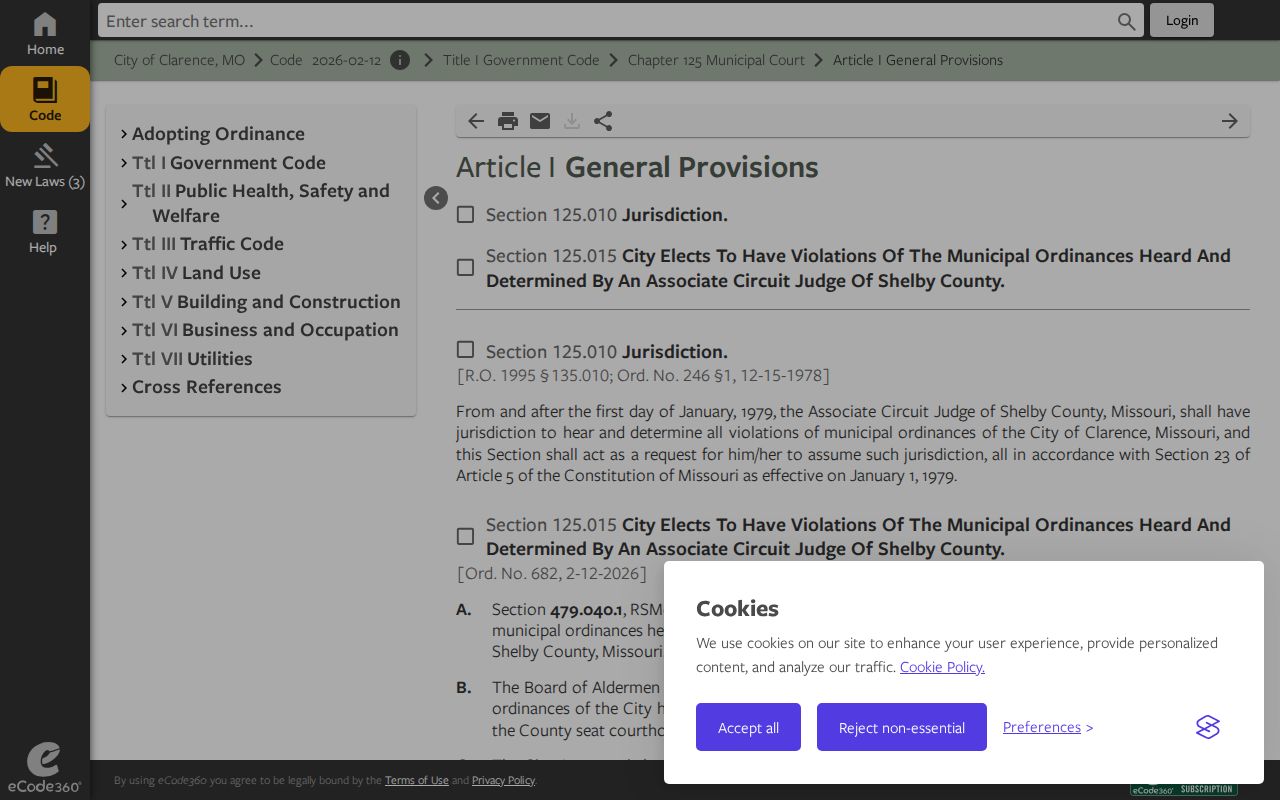
The Clarence code is the reason a searcher may need Clarence City Hall and the Shelby County Circuit Clerk for two parts of one Clarence event. Sending both requests to one office risks getting only half the Clarence record.
The Clarence Police Department
Clarence’s official site identifies a police function but does not publish a dedicated records counter page, request form, fee schedule, app, or hours. Use Clarence’s official contact route and ask for the person designated to keep police records. Confirm whether a Clarence request may be emailed or must be mailed or delivered. Do not assume the associate circuit clerk owns the Clarence police narrative simply because that clerk handles the resulting ordinance case.
A narrow request should give the report number when known, incident date and approximate time, location, involved party, exact record, preferred format, and a maximum cost authorization. Ask for inspection if that would avoid copy expense. Missouri law permits some investigative, juvenile, victim, medical, and personal data to be closed, so ask for all open portions and a written statute citation for withheld material.
The official City of Clarence site is the proper city-level starting point.

The city source confirms the local government channel. It does not create an online criminal-record database, so direct custodian contact remains necessary.
Compare Clarence Criminal Records
A single Clarence event can leave several files. The officer’s report is agency-centered. A jail entry is custody-centered. The ordinance or state case is court-centered. A MACHS record is identity-centered and may receive later charge and disposition reports. These records can update on different dates and can use different charge language.
| Clarence source | Best for | Not a substitute for |
|---|---|---|
| City police custodian | Initial incident and arrest narrative | Final court disposition |
| Shelby County sheriff | Booking, current hold, bond, release | Police investigation file |
| Associate circuit court | Ordinance or state case docket and judgment | Unfiled police allegation |
| MACHS | Statewide open repository history | Certified local case file |
A charge is still an allegation. Read the disposition for every count. One case can include a dismissal, amended count, plea, and sentence without one broad status label explaining the whole result.
Arrests and Bookings in Clarence
No official Clarence booking facility, arrest blotter, or online jail roster was identified. Call the Shelby County sheriff with a legal name and approximate arrest time. Ask whether the person is in custody, which facility received the person, and whether booking number, charge, bond, next court, or release details are available. If a contracted jail is used, obtain its official contact from the sheriff.
Booking takes place before the prosecutor’s final filing decision. Intake may include identity checks, property inventory, a photo, fingerprints, charges or holds, and bond information. The prosecutor can decline or alter the suggested charge. Case.net may not show a new file at once, and a person can be released before the docket appears. Absence from a web search is therefore not proof that no arrest occurred.
Note: Clarence has no official online blotter or police app, so keep the city, sheriff, and clerk channels distinct and current.
Search Clarence Court Records
Case.net is the public search layer for Clarence ordinance cases handled by the associate circuit judge and for state cases filed in Shelby County. Search by litigant name, case number, or filing date. Narrow to Shelby County, the 41st Judicial Circuit, and the fitting municipal, traffic, or criminal type when those controls are available. Common names require more facts than spelling alone.
Open the result and inspect the filing date, court, case status, each count, statute or ordinance, plea, disposition, hearings, docket entries, judgment, and public cost data. A docket event can suggest a warrant, but it is not guaranteed real-time warrant confirmation. Call the issuing court or law enforcement before relying on that status.
Note: “Disposed” says the case ended; it does not tell whether each Clarence charge ended in conviction, dismissal, or another outcome.
Clarence Municipal Court Records
The Clarence Municipal Court page explains that Missouri municipal courts hear city ordinance violations.
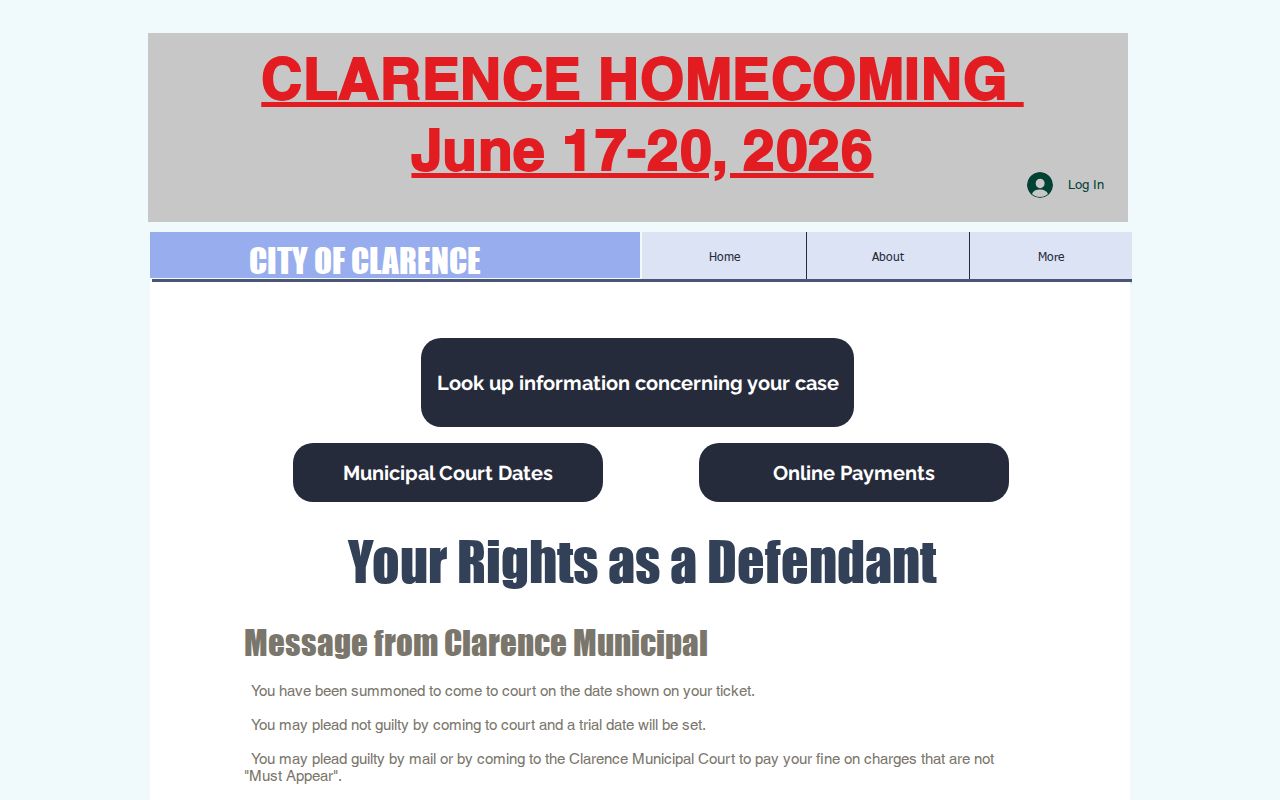
The page is informational and has no search fields. Use Case.net for the public docket and call the Shelby County Circuit Clerk at 573-633-2151 or 573-633-2251 for documents, certification, older files, and current copy costs.
| Court Name | Clarence ordinance docket heard by a Shelby County associate circuit judge at the county-seat courthouse. |
|---|---|
| Case Types Heard | Clarence city ordinance violations; state charges follow the appropriate associate or circuit route. |
| Case Lookup Channel | Missouri Case.net, followed by the Shelby County Circuit Clerk. |
| What the Docket Shows | Case number, filing date, charge or ordinance, court events, plea, disposition, judgment, and public costs. |
| Copies & Fees | No local court copy or certification schedule was published; ask the clerk before ordering. |
Fine-only ordinance allegations and state misdemeanors are not interchangeable. The filed law and court division identify which process applies.
Clarence Record Context
Clarence had 738 residents in the 2020 Census. That makes it Shelby County’s second-largest incorporated city, but still a small records jurisdiction. A few incidents can shift a per-capita rate sharply, and incomplete agency coverage can distort comparisons. No official current Clarence offense table was located, so city criminal-record searches should focus on the identified event and source rather than a broad claim about local trends.
The strongest local fact is institutional, not statistical: the city keeps its police narrative while the county-seat judge handles its ordinance docket. This division is more useful to a record requester than an uncited crime-rate estimate. It tells the reader where the actual documents live and why both city and county contact may be required.
Clarence was smaller than Shelbina but larger than Shelbyville in the official incorporated-place ranking. Population rank does not control court jurisdiction. Clarence’s own code does. Nor does population identify the arresting agency, the receiving jail, or the final charge. Those facts must come from the report, booking custodian, and docket for the event at issue.
Where Clarence Records End Up
A reportable Clarence arrest can send fingerprints and identifiers through Missouri’s criminal-justice network to the Central Repository. Prosecutor filings and court dispositions later update the repository. The local police report does not move there as a full narrative. Older voluntary reporting, delayed fingerprints, missing outcomes, and name mismatches can leave gaps.
Record flow: Clarence Police Department › Shelby County Courts › Missouri State Highway Patrol Criminal Justice Information Services Division, Missouri Central Repository
The Clarence path helps explain timing. Ask Clarence for the fresh report, the sheriff for Clarence custody, the clerk for the filed Clarence case, and MACHS for the statewide repository product. Fingerprints provide positive identification for a person reviewing their own open and closed Missouri history.
Repository data dates back to the 1940s, while mandatory reporting began in 1987. Older voluntary reporting can leave gaps. Agencies report current records daily, but daily updating does not mean every Clarence event arrives at once. A missing disposition can persist until the court or prosecutor submits the final result, and a spelling mismatch may keep related entries from lining up under a name.
Clarence Identity Record Boundary
Missouri and federal identity-history checks answer different questions. A MACHS name check covers open Missouri repository records and costs $15 plus the electronic convenience fee. A fingerprint check is the stronger identity route for a person reviewing their own Missouri record. An FBI Identity History Summary is available only to the subject and concerns federal repository data, not a certified Clarence police file.
The official FBI electronic identity history request shows the online federal self-review channel, while the FBI's Identity History Summary instructions cover the broader request process.
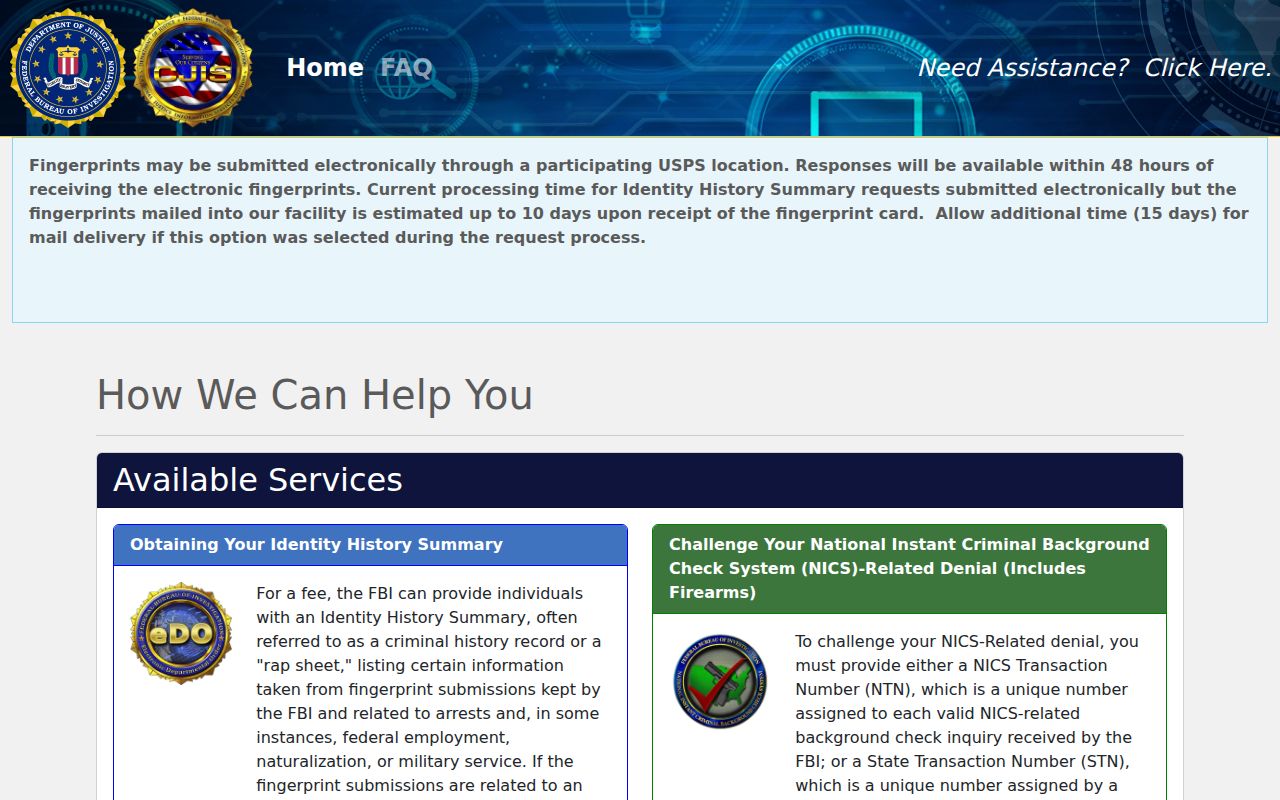
The federal route is useful only for its stated scope. A person who needs a Clarence incident narrative still must request it from the Clarence city custodian.
Clarence Closed Criminal Records
Public searches omit juvenile, expunged, sealed, and other confidential material. Missouri also distinguishes public access from authorized criminal-justice access. A closed record can remain available for uses the law permits even when it disappears from the ordinary Case.net or name-search view. An incomplete public result should not be stretched into a claim that no underlying record exists.
RSMo §610.120 describes the effect of closing records and authorized access.
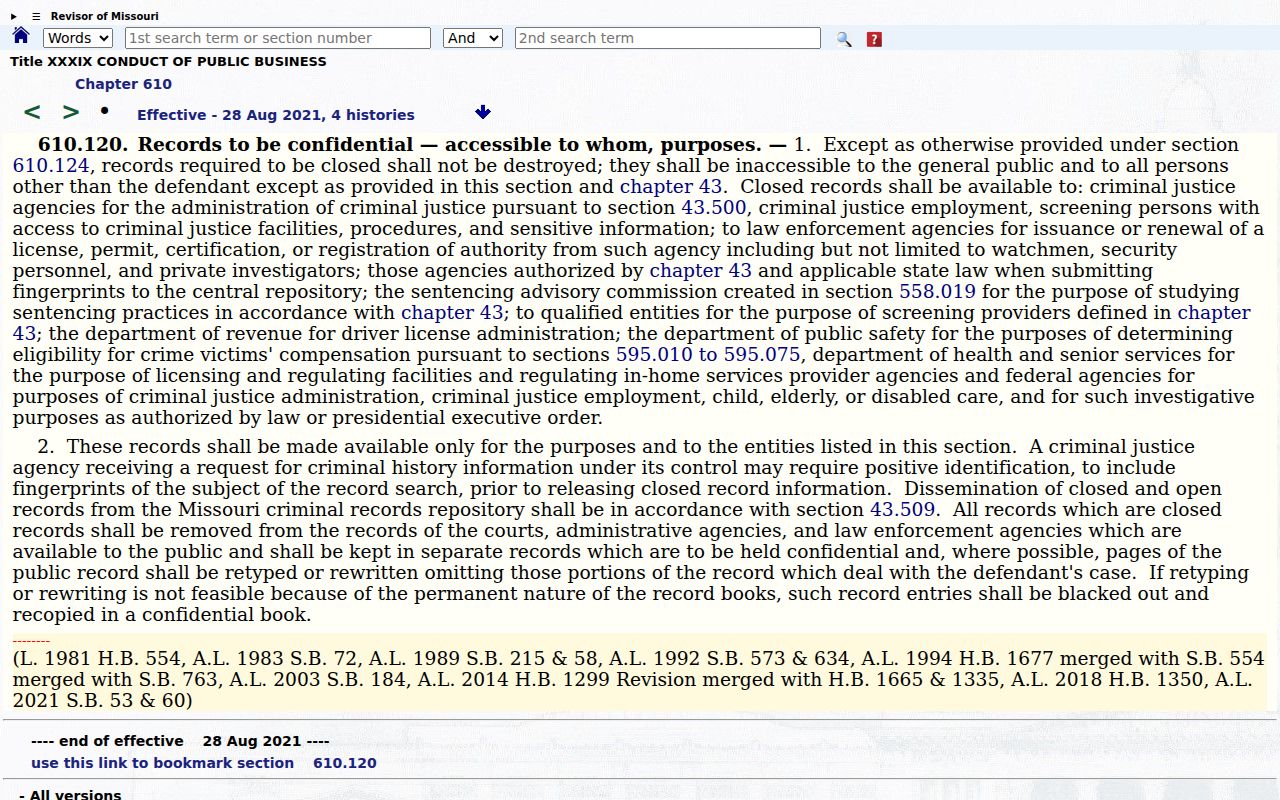
The statute supplies the legal boundary. Questions about a Clarence court record should begin with the circuit clerk, while repository self-review belongs with the official fingerprint process.
Expungement is different from a mere dismissal. Missouri §610.140 sets a petition process, exclusions, waiting rules, and lifetime limits. The person must identify the offenses and agencies that hold records so an order reaches each custodian. When a Clarence ordinance or criminal matter qualifies, the circuit clerk can provide the current pro se form and confirm filing details.
Public Access Rules
The Missouri Sunshine Law applies to Clarence city records, but it does not make every line public. Initial arrest reports generally open, while investigative material may remain closed during an active inquiry. Juvenile, victim, medical, personal-identifier, and protected attachments can be withheld. Court rules separately protect confidential case material. Ask for separable open portions rather than treating a partial closure as a reason to abandon the request.
Key Statutes:
Missouri Sunshine Law, Chapter 610 favors access to public records subject to specific statutory closures.
RSMo §610.100 defines arrest, incident, and investigative records and states when they may close.
RSMo §43.530 governs dissemination of open and restricted Missouri criminal-history information.
Note: Ask the Clarence custodian to cite the precise law for any denial and to release the open parts of a mixed record.
Clarence did not publish a local police copy fee or response form. Ask for a written estimate under §610.026 and specify that inspection is acceptable if it cuts duplication cost. The request should also state a delivery format and cost ceiling. These details give the custodian a clear task without broadening the request into every record that happens to share a name.